Why a Running Track Curves at the Ends
Why a running track curves at the ends: see how the oval keeps laps continuous and makes straights, bends and runner positions easier to read.
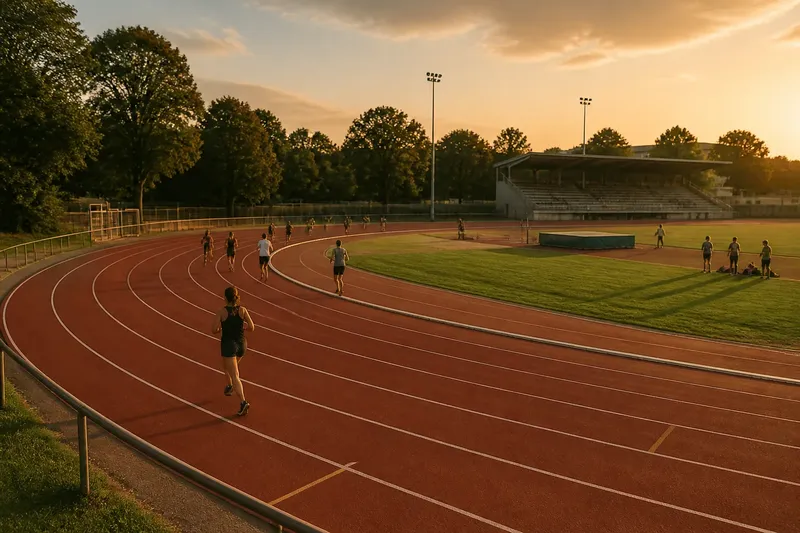
A running track curves at the ends so runners can keep moving in one continuous loop without losing sight of where a lap begins and ends. The oval also gives spectators a clear view of the straight sections and turns, while lane markings make each runner’s route legible from the infield or stands.
What does the oval make easier?
Start by looking at the track as a route rather than a painted shape. Each lap joins two straights with two bends, so a runner can move from one section to the next without stopping, turning sharply or crossing another lane to reverse direction. That continuity suits races, training sessions and casual laps alike.
The straights provide recognisable stretches for accelerating, settling into pace or watching a finish. The curves connect them while keeping the overall route compact enough to follow from a fixed position. For a spectator, the runner does not disappear around a corner as they might on a winding course; the bend stays within the same shared space.
The shape also gives everyone a common reference. A coach can call out that a runner is approaching the home straight, while a participant can identify the far bend without needing signs at every turn. Those names describe visible parts of the venue, not abstract distances.
How do the straights and bends guide a lap?
Follow one lane with your eyes. The two straights form parallel sides, and the bends join their ends. As runners travel in the usual direction, they pass from one straight into a bend, continue around the curve, then emerge onto the next straight. The sequence repeats, so the lap is easy to recognise even when several people are moving at different speeds.
Lane lines help separate those routes. A runner who remains within a lane can see the boundary on either side and judge where to place their steps. The curved lines also make the bend’s shape visible: each lane follows its own arc rather than sharing a single turning point. This lets participants occupy parallel paths without converging at the corner.
For viewers, the bends reveal movement in stages. A group entering the turn is still visible as it arcs towards the far straight, and a runner leaving it becomes easier to distinguish against the straight’s open view. The layout therefore makes a lap readable both as a complete circuit and as a series of familiar sections.
How should you read lane markings before joining in?
Before stepping onto the track, pause at an entrance and look for directional arrows, lane numbers and any venue notice about permitted use. Find out which lanes are intended for faster running, walking, warm-ups or organised sessions. Tracks differ, and a lane’s usual purpose may change during a booked event.
Next, identify the start and finish markings relevant to your activity. A track can carry several start lines because different race distances require different starting points. Do not assume that every prominent line marks the start of a standard lap; look for the venue’s signs or ask staff if the markings are unclear.
Then check how users are expected to share the oval. If you are jogging, stay alert to faster runners approaching from behind and move out of their path only when it is safe to do so. If you are stopping, stretching or talking, step clear of the running line rather than gathering on a bend or just beyond a finish marking. Follow posted directions and local rules; where a rule depends on the facility, its notice or staff instruction takes precedence.
Why do the bends look different across lanes?
The inside lane follows the tightest curve, while each lane outside it describes a broader arc. That difference means runners in outer lanes travel farther around a bend than runners in inner lanes if they start level with one another. In a race, staggered starting positions account for this, placing some competitors ahead so their routes cover comparable distances.
For everyday running, the practical point is simple: a lane is a route with its own curve, not merely a strip of spare space. If you move from one lane to another, do so with a clear view and without cutting across someone else’s path. On a busy session, staying predictable matters more than claiming the shortest-looking line.
Say you arrive for a relaxed lap while a faster group is using the inside lane. You choose an open outer lane, check for approaching runners before entering, and keep your path steady around the bends. The group can pass without a sudden weave, and you can follow the same continuous loop without disrupting their session.
What should you look for on your first circuit?
Use one easy lap to learn the track’s landmarks rather than trying to memorise every painted line at once. Notice the entrance, the home straight, the far straight and the two bends. Check where people enter and leave, and see whether there is a customary direction of travel.
Keep these details in mind:
- Direction: Find any arrows or venue instructions before joining the flow.
- Lane use: Check which lanes are open to casual runners and which are reserved.
- Start markings: Identify the line used for your session instead of guessing from colour or position.
- Passing space: Look for room to overtake without forcing another runner towards the edge.
- Resting places: Choose an area outside the active route for a pause or conversation.
There is little benefit in trying to decode every distance marking before you start if you are only taking an easy lap. Learn the route and the sharing rules first; return to the finer markings when a session calls for them.
What do runners often ask about track curves?
Why are the ends not straight corners?
A curve lets runners change direction gradually while staying on a continuous route. It also keeps the bend visible as part of the oval, rather than creating a sharp corner where runners would need to make a sudden turn.
Why do races start at different points?
Different distances use different start markings, and staggered starts can account for the extra distance travelled in outer lanes. Use the line specified for the event rather than treating the finish line as every race’s starting point.
Is the inside lane always the right place to run?
No; lane use depends on the venue and the activity taking place. Check posted guidance, then choose a lane that lets you run predictably without obstructing faster users.
Can walkers use a running track?
Some facilities allow walking at particular times or in designated lanes, while others reserve the track for scheduled activity. Check the venue’s current rules before joining the oval.
How does the oval help everyone share the space?
The track’s shape gives participants a route they can follow and gives onlookers a sequence they can understand: straight, bend, straight, bend. Lane lines distinguish parallel paths, while familiar landmarks make it easier to communicate about a runner’s position. That shared visual language is part of what makes the oval useful as a sporting place, not just a course.
Keep the central idea in view when you arrive: the curve is a connector, not a detour. Read the markings, choose a suitable lane and follow the venue’s flow. Once the straights and bends make sense, a running track becomes much easier to enter, share and watch.