A First Lap Around an Unfamiliar Park
A first lap around an unfamiliar park helps you spot useful paths, places to pause and active areas before choosing a route that feels right to repeat.
A first lap around an unfamiliar park is best treated as a survey, not a workout. Walk at an easy pace, notice where paths lead and where people pause, then decide whether any part of the park suits a route you would enjoy repeating. You do not need to cover every corner or settle on a distance today.
That small change in purpose takes pressure off the visit. You can pay attention to the park itself: the ground underfoot, the way paths meet, the places that feel comfortable to stop and the activity areas that shape the park’s rhythm.
What should you notice before setting off?
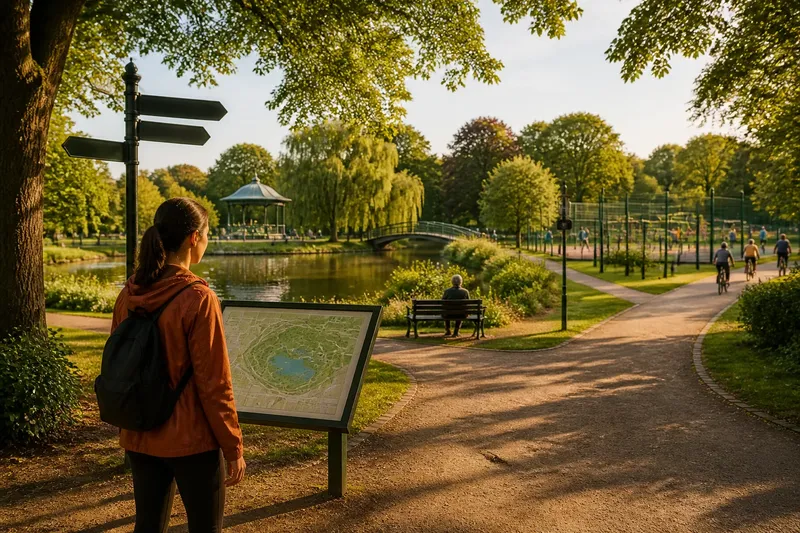
At the entrance, pause long enough to get your bearings. Look for a park map, a sign naming paths or facilities, and the main directions people are heading. If there is no map, choose a clear path and note a landmark you can recognise on the way back, such as a footbridge, a distinctive gate or a bandstand.
Watch the ground as well as the scenery. A wide, firm path may be comfortable for an easy walk, while a narrow track through grass can become muddy or uneven. Notice where the surface changes, whether the path is shared with cyclists, and whether there are junctions where a newcomer could lose their bearings.
Listen for the park’s everyday sounds. A busy play area, a ball game or a path beside a road can affect where you might want to linger. These are observations, not ratings: a lively area may be exactly what you want, or it may make a quieter loop more appealing.
How do the paths connect?
Think of the park as a set of choices rather than one route. Notice which paths form loops, which return towards the entrance and which seem to continue into another section. A path that looks promising on a map may end at a gate or lead to a different exit, so keep track of the turns that matter to you.
At each junction, glance back before moving on. The view in the opposite direction can look surprisingly different, particularly where trees or buildings block familiar landmarks. A quick mental note such as “the gravel path meets the broad path beside the pond” is often more useful than trying to memorise every bend.
Pay attention to shared use. Some parks mark cycle routes, walking paths or bridleways; others rely on people to make room for one another. Keep to the indicated route where signs provide one, leave room for others to pass and avoid stopping in a narrow section while studying a map.
Where could you pause without blocking anyone?
Resting points tell you how a park supports a slower visit. Look for benches, low walls, shaded clearings and places beside a view. A good pause need not be a formal seat: it might be a broad area off the path where you can drink water, adjust a layer or watch a game without getting in anyone’s way.
Check whether a bench is exposed to wind or close to a busy crossing. Notice if the approach is firm underfoot and whether there is room for a mobility aid, pushchair or companion to join you. These details can make a place more practical than a picturesque spot that is hard to reach.
Not every inviting edge is a suitable resting place. Avoid sitting on planted areas, blocking a gate or taking over the edge of a pitch. If the park has marked quiet zones or areas reserved for a particular activity, respect those signs and look for a nearby place intended for general use.
What is happening in the active areas?
Take in the activity areas from their edges before choosing to join anything. A court, outdoor gym, skate space or open field each has its own pattern of movement. Notice where people enter and leave, where equipment is stored and whether there is an informal waiting area.
For a first visit, the aim is simply to understand how the space is used. A court may be booked or occupied by a group; a field might be used for casual play; an outdoor fitness station may be in use in a sequence you do not yet recognise. Give participants room, and do not cross a playing area to shorten your route when a path goes around it.
Look for the boundary between activity and through-route. If a path runs beside a ball game, decide whether it feels comfortable to walk there while play is underway. You can choose a quieter alternative without judging the people using the space.
Which details help you choose a repeatable route?
Once you have seen a little of the park, choose one manageable section to remember. A route is easier to repeat when it has a clear start, a landmark or two and a straightforward return. It might be a loop around a pond, a broad path to a garden and back, or a short circuit that passes a bench where you can pause.
Do not make the route depend on a single detail that could be hard to spot later. Pair a visible landmark with a direction: for instance, follow the main path towards the pavilion, then take the path that bends back beside the trees. If signs give path names or symbols, use them as well as the scenery.
Imagine you enter beside a library and find a wide path leading towards a pond, with a bench near the water and a second path returning through a tree-lined section. You could walk to the pond, pause where the bench is clear, then follow the return path to the library entrance. The observable result is a simple loop with two recognisable points, which you can revisit or alter without needing to explore the whole park again.
What should you look for in a first lap around an unfamiliar park?
Should you follow the park map exactly?
Use the map to understand the layout, but compare it with the signs and paths you can actually see. If a route is closed or the map is unclear, stay on an open, signed path and keep an easy way back in view.
Is it better to walk or jog on the first visit?
Walking makes it easier to notice junctions, surfaces and places to stop. If you prefer to jog, keep the pace gentle enough to pay attention and leave the route choice until you have seen how the paths connect.
How can you tell whether a path is busy?
Pause somewhere out of the way and watch how people share it. Look for cyclists, runners, dog walkers and groups approaching from different directions, then choose a wider or quieter section if you would rather move without frequent interruptions.
What if the park feels larger than expected?
Turn back using a landmark you already recognise rather than pushing on to find every exit. You can explore another section on a later visit, starting from the entrance or path you now know.
What is not worth the effort on a first visit?
There is little value in trying to memorise every path, identify every facility or choose a perfect route before you have felt how the park works. Skip detailed note-taking unless it genuinely helps you; a couple of landmarks and one appealing section are enough to make the next visit more familiar.
Likewise, do not treat the first lap as a test of fitness. A slow survey can reveal more about the park than a hurried circuit, and it leaves room to stop when something catches your attention.
How can you leave yourself a useful next visit?
Before leaving, name the section you might return to and the landmark that would help you find it. Keep the note plain: “pond loop from the south gate” or “broad path past the outdoor court”. If the park has several entrances, remember which one you used and whether you want to begin there again.
Check any posted signs for route closures, shared-use rules or facility access before relying on a particular path or area. Where access depends on local rules or the park operator’s instructions, follow those directions rather than assuming every space is open to everyone.
A first lap around an unfamiliar park does not need to produce a fixed routine. It can leave you with a useful choice: a path to repeat, a quiet place to pause, or a lively corner to explore next time. That is enough to turn a large, unfamiliar green space into somewhere you can return to with more confidence and curiosity.